<?xml version="1.0" encoding="utf-8"?><feed xmlns="http://www.w3.org/2005/Atom" ><generator uri="https://jekyllrb.com/" version="3.10.0">Jekyll</generator><link href="https://starrysky422.github.io/feed.xml" rel="self" type="application/atom+xml" /><link href="https://starrysky422.github.io/" rel="alternate" type="text/html" /><updated>2026-04-17T02:37:16-04:00</updated><id>https://starrysky422.github.io/feed.xml</id><title type="html">Mathematical Scribbles</title><subtitle>A personal website about random mathematical stuff I study.</subtitle><author><name>Starrysky</name><email>yhun_jo@mit.edu</email></author><entry><title type="html">Exponential Mixing and Transfer Operators</title><link href="https://starrysky422.github.io/2024/11/26/exponential-mixing-and-transfer-operators/" rel="alternate" type="text/html" title="Exponential Mixing and Transfer Operators" /><published>2024-11-26T00:00:00-05:00</published><updated>2024-11-26T00:00:00-05:00</updated><id>https://starrysky422.github.io/2024/11/26/exponential-mixing-and-transfer-operators</id><content type="html" xml:base="https://starrysky422.github.io/2024/11/26/exponential-mixing-and-transfer-operators/"><![CDATA[<p>In November 2024, I gave a talk at the final presentation session for the course <em>Topics in Topology (Ergodic Theory with a view towards Number Theory)</em> by <a href="http://www.math.snu.ac.kr/~lim/">Prof. Seonhee Lim</a>. I introduced the transfer operator framework for establishing the exponential mixing properties of dynamical systems. In particular, I covered proofs of exponential mixing of one-dimensional expanding maps, and geodesic flows on compact surfaces of variable negative curvature. The talk was based on Pollicott’s lecture notes [6].</p>

<h2 id="abstract">Abstract</h2>
<p>Transfer operators offer a powerful framework for establishing the exponential mixing properties of dynamical systems and, in certain cases, provide the only available approach. In this talk, we explore the methodology for proving exponential mixing through the spectral analysis of transfer operators, highlighting the key concepts and techniques involved.</p>

<h2 id="slides">Slides</h2>
<p>These are the slides for my talk.</p>
<details>
<summary>Click to expand</summary>
<object data="/assets/2024-11-26-exponential-mixing-and-transfer-operators/ExpMix.pdf" width="700" height="1000" type="application/pdf"></object>
</details>

<h2 id="references">References</h2>
<p>[1] Bowen, R. and C. Series, <em>Markov maps associated with Fuchsian groups</em>, Publications Mathématiques de l’IHÉS <strong>50</strong> (1979), 153–170.</p>

<p>[2] Boyarsky, A. and P. Gora, <em>Laws of Chaos: Invariant Measures and Dynamical Systems in One Dimension</em>, Birkhäuser, 1997.</p>

<p>[3] Dolgopyat, D., <em>On decay of correlations in Anosov flows</em>, Annals of Mathematics <strong>2</strong> (1998), 357–390.</p>

<p>[4] Galatolo, S., <em>Statistical properties of dynamics: Introduction to the functional analytic approach</em>, arXiv preprint (2015), arXiv:1510.02615</p>

<p>[5] Katok, S., and I. Ugarcovici, <em>Symbolic dynamics for the modular surface and beyond</em>, Bulletin of the American Mathematical Society <strong>44</strong> (2007), 87–132.</p>

<p>[6] Pollicott, M., <em>Exponential Mixing: Lectures from Mumbai</em>, Geometric and Ergodic Aspects of Group Actions. Springer, 2020. 135–167.</p>

<p>[7] Walkden, C., <em>MAGIC: Ergodic Theory Lecture 9 - Thermodynamic Formalism</em>, Electronic Edition, 2013. (<a href="https://personalpages.manchester.ac.uk/staff/charles.walkden/magic/lecture09.pdf">Online</a>)</p>]]></content><author><name>Starrysky</name><email>yhun_jo@mit.edu</email></author><category term="Ergodic Theory" /><category term="Talk" /><summary type="html"><![CDATA[In November 2024, I gave a talk at the final presentation session for the course Topics in Topology (Ergodic Theory with a view towards Number Theory) by Prof. Seonhee Lim. I introduced the transfer operator framework for establishing the exponential mixing properties of dynamical systems. In particular, I covered proofs of exponential mixing of one-dimensional expanding maps, and geodesic flows on compact surfaces of variable negative curvature. The talk was based on Pollicott’s lecture notes [6].]]></summary></entry><entry><title type="html">Random Walks and Invariant Random Subgroups</title><link href="https://starrysky422.github.io/2024/11/15/random-walks-and-invariant-random-subgroups/" rel="alternate" type="text/html" title="Random Walks and Invariant Random Subgroups" /><published>2024-11-15T00:00:00-05:00</published><updated>2024-11-15T00:00:00-05:00</updated><id>https://starrysky422.github.io/2024/11/15/random-walks-and-invariant-random-subgroups</id><content type="html" xml:base="https://starrysky422.github.io/2024/11/15/random-walks-and-invariant-random-subgroups/"><![CDATA[<p>In November 2024, I gave a talk at the Seoul National University Dynamics Seminar, supervised by <a href="https://www.math.snu.ac.kr/~lim/">Prof. Seonhee Lim</a>. I introduced basic concepts related to random walks on groups, the notion of invariant random subgroups, and generalizations of the tools for random walks on groups to random coset spaces.</p>

<h2 id="abstract">Abstract</h2>
<p>Upon first introduced by Kesten in 1959, the study of random walks on groups has proven to be a valuable method for investigating group structures, giving rise to many intriguing questions. Meanwhile, invariant random subgroups have emerged as central objects in the study of group actions, serving as natural generalizations of normal subgroups and lattices. 
In the first part of this talk, we will introduce fundamental concepts related to random walks on groups, including the Poisson–Furstenberg boundary and Avez asymptotic entropy. In the second part, we will present the notion of invariant random subgroups and discuss related results. Finally, we will address generalizations of former results on random walks on groups, extending them to random coset spaces, which are quotients by invariant random subgroups.</p>

<h2 id="slides">Slides</h2>
<p>These are the slides for my talk.</p>
<details>
<summary>Click to expand</summary>
<object data="/assets/2024-11-15-random-walks-and-invariant-random-subgroups/RW and IRS.pdf" width="700" height="1000" type="application/pdf"></object>
</details>

<h2 id="references">References</h2>
<p>[1] Abért, M., <em>Invariant Random Subgroups and Their Applications</em>, Slides from a presentation at IHP, 2014. (<a href="https://users.renyi.hu/~abert/IRS_talk.pdf">Online</a>)</p>

<p>[2] Benjamini, I. and G. Kozma, <em>Nonamenable liouville graphs</em>, arXiv preprint, 2010. arXiv: 1010.3365</p>

<p>[3] Bowen, L., <em>Random walks on random coset spaces with applications to Furstenberg entropy</em>, Inventiones Mathematicae <strong>196</strong> (2014), 485-510.</p>

<p>[4] Furman, A., <em>Random walks on groups and random transformations</em>, Handbook of Dynamical Systems Volume 1A. Elsevier Science, 2002. 931-1014.</p>

<p>[5] Gelander, T., <em>Lecture notes on Invariant Random Subgroups and Lattices in rank on and higher rank</em>, arXiv preprint, 2015. arXiv: 1503.08402</p>

<p>[6] Kaimanovich, V. A. and A. M. Vershik, <em>Random walks on discrete groups: boundary and entropy</em>, The Annals of Probability <em>11</em> (1983), 457-490.</p>

<p>[7] Lalley, S. P., <em>Random Walks on Infinite Discrete Groups</em>, Electronic Edition, 2018. (<a href="https://sites.math.northwestern.edu/~auffing/SNAP/rw-northwestern.pdf">Online</a>)</p>

<p>[8] Lyons, R. and Y. Peres, <em>Probability on Trees and Networks</em>. Cambridge University Press, 2017.</p>

<p>[9] Tamuz, O., <em>Lecture Notes on Random Walks</em>, Electronic Edition, 2022. (<a href="https://www.tamuz.caltech.edu/teaching/ma140b/lectures.pdf">Online</a>)</p>

<p>[10] Yadin, A., <em>Harmonic Functions and Random Walks on Groups</em>. Cambridge University Press, 2024.</p>

<p>[11] Zheng, T., <em>Asymptotic behaviors of random walks on countable groups</em>, Proceedings of the International Congress of Mathematicians, 2022.</p>

<p>[12] Zheng, T., <em>Random Walks on Random Coset Spaces</em>, 13th Cornell Probability Summer School, 2024.</p>]]></content><author><name>Starrysky</name><email>yhun_jo@mit.edu</email></author><category term="Probability Theory" /><category term="Ergodic Theory" /><category term="Talk" /><summary type="html"><![CDATA[In November 2024, I gave a talk at the Seoul National University Dynamics Seminar, supervised by Prof. Seonhee Lim. I introduced basic concepts related to random walks on groups, the notion of invariant random subgroups, and generalizations of the tools for random walks on groups to random coset spaces.]]></summary></entry><entry><title type="html">Spin Glass Theory</title><link href="https://starrysky422.github.io/2024/10/29/spin-glass-theory/" rel="alternate" type="text/html" title="Spin Glass Theory" /><published>2024-10-29T00:00:00-04:00</published><updated>2024-10-29T00:00:00-04:00</updated><id>https://starrysky422.github.io/2024/10/29/spin-glass-theory</id><content type="html" xml:base="https://starrysky422.github.io/2024/10/29/spin-glass-theory/"><![CDATA[<p>In October 2024, I gave a talk at Peer Mathematics Seminar, a weekly peer seminar held in Department of Mathematical Sciences, Seoul National University. I discussed the construction of the Sherrington–Kirkpatrick model and the Parisi formula, and addressed the open problems involving the phase transition observed through the free energy. The contents of this talk were based on Prof. Antonio Auffinger’s lectures at 13th Cornell Probability Summer School.</p>

<h2 id="abstract">Abstract</h2>
<p>In recent decades, the study of spin glass models has enabled purely mathematical formulation of real-world phenomena and physical predictions for disordered systems, providing many intriguing results and significant questions in probability theory. In this talk, we will discuss the construction of the Sherrington–Kirkpatrick model and the Parisi formula, and address open problems related to the phase transition observed through the free energy.</p>

<h2 id="lecture-note">Lecture Note</h2>
<p>These are hand-written notes for my talk.</p>
<details>
<summary>Click to expand</summary>
<object data="/assets/2024-10-29-spin-glass-theory/20241029_SpinGlass.pdf" width="700" height="1000" type="application/pdf"></object>
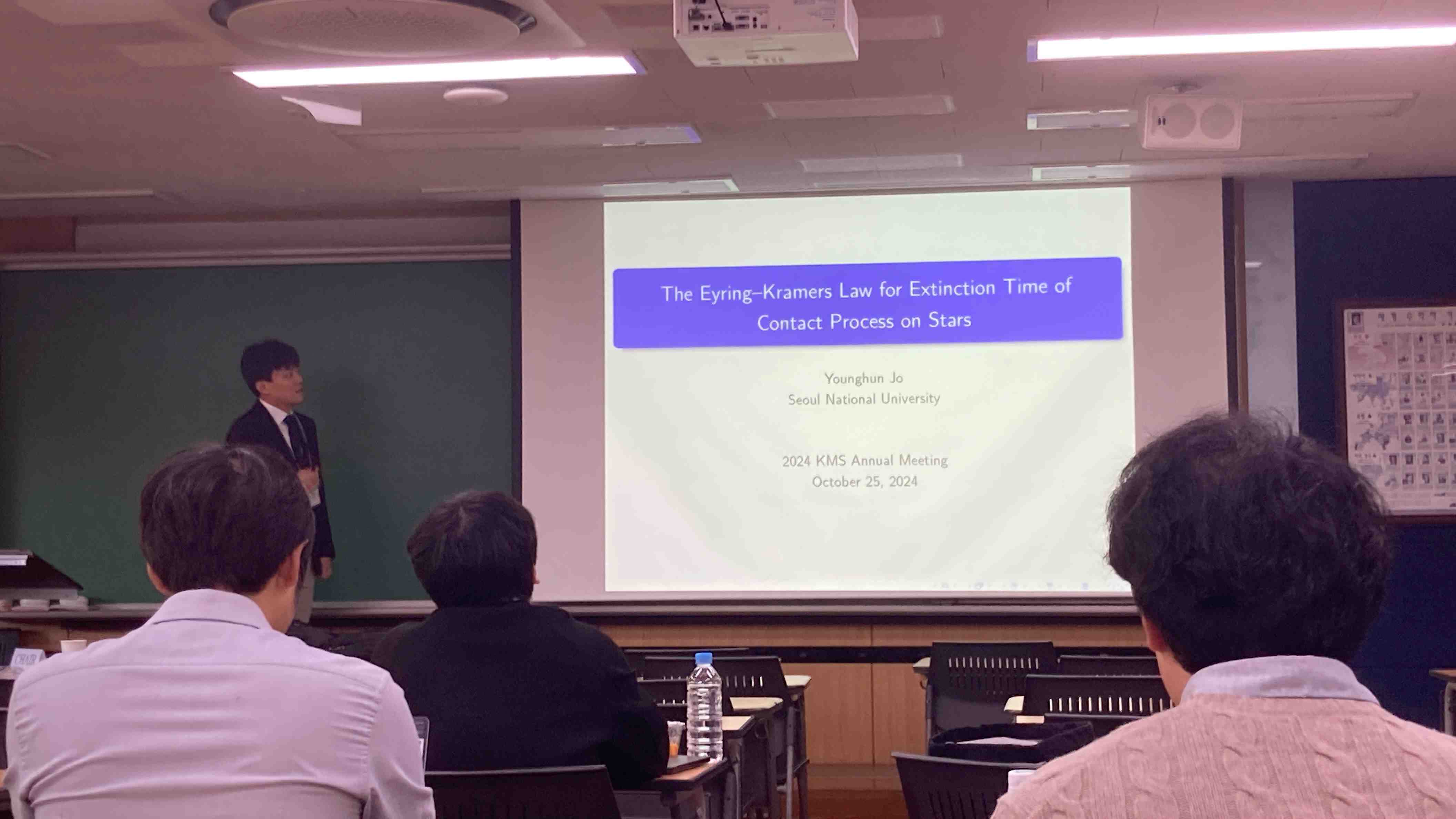
</details>]]></content><author><name>Starrysky</name><email>yhun_jo@mit.edu</email></author><category term="Probability Theory" /><category term="Spin Glass Theory" /><category term="Talk" /><summary type="html"><![CDATA[In October 2024, I gave a talk at Peer Mathematics Seminar, a weekly peer seminar held in Department of Mathematical Sciences, Seoul National University. I discussed the construction of the Sherrington–Kirkpatrick model and the Parisi formula, and addressed the open problems involving the phase transition observed through the free energy. The contents of this talk were based on Prof. Antonio Auffinger’s lectures at 13th Cornell Probability Summer School.]]></summary></entry><entry><title type="html">Research Talk at KMS Annual Meeting</title><link href="https://starrysky422.github.io/2024/10/25/research-talk-at-kms-annual-meeting/" rel="alternate" type="text/html" title="Research Talk at KMS Annual Meeting" /><published>2024-10-25T00:00:00-04:00</published><updated>2024-10-25T00:00:00-04:00</updated><id>https://starrysky422.github.io/2024/10/25/research-talk-at-kms-annual-meeting</id><content type="html" xml:base="https://starrysky422.github.io/2024/10/25/research-talk-at-kms-annual-meeting/"><![CDATA[<p>In October 2024, I gave an <a href="https://www.kms.or.kr/conference/abstract/search_view.html?num=9325&amp;uid=88">invited talk</a> at the <a href="https://www.kms.or.kr/conference/2024_fall/">2024 KMS Annual Meeting</a>. I presented a precise estimate for the mean extinction time of the contact process with a fixed infection rate on a star graph. The talk was based on my research advised by <a href="http://www.math.snu.ac.kr/~insuk.seo/">Prof. Insuk Seo</a>, and the preprint of my paper can be found on <a href="https://arxiv.org/abs/2405.09501">arXiv</a>.</p>

<h2 id="abstract">Abstract</h2>
<p>In this talk, we present a precise estimate for the mean extinction time of the contact process with a fixed infection rate on a star graph with $N$ leaves. Specifically, we determine not only the exponential main factor but also the sharp sub-exponential prefactor of the asymptotic formula for the mean extinction time as $N\to\infty$, a level of detail previously available only for complete graphs. We achieved these results by estimating the quasi-stationary distribution on non-extinction using special function theory and refined Laplace’s method, and by applying the potential theoretic approach to metastability of non-reversible Markov processes. This novel integration of methodologies provides new insights into the study of the contact process.</p>

<h2 id="slides">Slides</h2>
<p>These are the slides for my talk.</p>
<details>
<summary>Click to expand</summary>
<object data="/assets/2024-10-25-research-talk-at-kms-annual-meeting/ContactKMS.pdf" width="700" height="1000" type="application/pdf"></object>
</details>

<h2 id="photo">Photo</h2>
<p><img src="/assets/2024-10-25-research-talk-at-kms-annual-meeting/photo_resized.jpg" alt="Talk Photo" width="100%" style="float:none" /></p>]]></content><author><name>Starrysky</name><email>yhun_jo@mit.edu</email></author><category term="Probability Theory" /><category term="Metastability" /><category term="Contact Process" /><category term="Talk" /><summary type="html"><![CDATA[In October 2024, I gave an invited talk at the 2024 KMS Annual Meeting. I presented a precise estimate for the mean extinction time of the contact process with a fixed infection rate on a star graph. The talk was based on my research advised by Prof. Insuk Seo, and the preprint of my paper can be found on arXiv.]]></summary></entry><entry><title type="html">Random Walks on Groups</title><link href="https://starrysky422.github.io/2024/10/02/random-walks-on-groups/" rel="alternate" type="text/html" title="Random Walks on Groups" /><published>2024-10-02T00:00:00-04:00</published><updated>2024-10-02T00:00:00-04:00</updated><id>https://starrysky422.github.io/2024/10/02/random-walks-on-groups</id><content type="html" xml:base="https://starrysky422.github.io/2024/10/02/random-walks-on-groups/"><![CDATA[<p>In October 2024, I gave a talk at Peer Mathematics Seminar, a weekly peer seminar held in Department of Mathematical Sciences, Seoul National University. I discussed the construction of random walks on groups and introduced important concepts that appear in this field: harmonic functions, the Poisson–Furstenberg boundary, and Avez asymptotic entropy.</p>

<h2 id="abstract">Abstract</h2>
<p>Random walks on groups were first introduced by Kesten in 1959. The study of these random walks has become a valuable method for exploring group structures, leading to many intriguing questions. In this talk, we will discuss the construction of random walks on groups and introduce some fundamental concepts, such as harmonic functions, the Poisson–Furstenberg boundary, and Avez asymptotic entropy.</p>

<h2 id="lecture-note">Lecture Note</h2>
<p>These are hand-written notes for my talk.</p>
<details>
<summary>Click to expand</summary>
<object data="/assets/2024-10-02-random-walks-on-groups/20241002_RW on Groups.pdf" width="700" height="1000" type="application/pdf"></object>
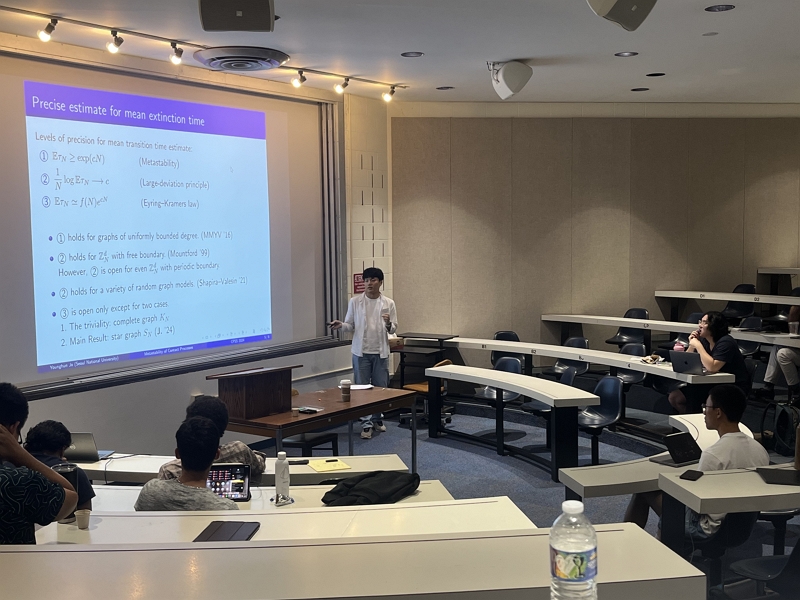
</details>]]></content><author><name>Starrysky</name><email>yhun_jo@mit.edu</email></author><category term="Probability Theory" /><category term="Ergodic Theory" /><category term="Talk" /><summary type="html"><![CDATA[In October 2024, I gave a talk at Peer Mathematics Seminar, a weekly peer seminar held in Department of Mathematical Sciences, Seoul National University. I discussed the construction of random walks on groups and introduced important concepts that appear in this field: harmonic functions, the Poisson–Furstenberg boundary, and Avez asymptotic entropy.]]></summary></entry><entry><title type="html">Short Talk at Cornell Probability Summer School</title><link href="https://starrysky422.github.io/2024/07/26/short-talk-at-cornell-probability-summer-school/" rel="alternate" type="text/html" title="Short Talk at Cornell Probability Summer School" /><published>2024-07-26T00:00:00-04:00</published><updated>2024-07-26T00:00:00-04:00</updated><id>https://starrysky422.github.io/2024/07/26/short-talk-at-cornell-probability-summer-school</id><content type="html" xml:base="https://starrysky422.github.io/2024/07/26/short-talk-at-cornell-probability-summer-school/"><![CDATA[<p>In July 2024, I gave a short talk at the <a href="https://math.cornell.edu/13th-cornell-probability-summer-school">13th Cornell Probability Summer School</a>. I briefly introduced the current state of knowledge regarding the metastability of contact processes on finite graphs. In particular, I discussed precise estimates of the mean extinction time for specific cases, and presented the main result of my paper that can be found on <a href="https://arxiv.org/abs/2405.09501">arXiv</a>.</p>

<h2 id="slides">Slides</h2>
<p>These are the slides for my talk.</p>
<details>
<summary>Click to expand</summary>
<object data="/assets/2024-07-26-short-talk-at-cornell-probability-summer-school/Contact_Younghun Jo.pdf" width="700" height="1000" type="application/pdf"></object>
</details>

<h2 id="photo">Photo</h2>
<p><img src="/assets/2024-07-26-short-talk-at-cornell-probability-summer-school/1722048851829_resized.jpg" alt="Talk Photo" width="100%" style="float:none" /></p>]]></content><author><name>Starrysky</name><email>yhun_jo@mit.edu</email></author><category term="Probability Theory" /><category term="Metastability" /><category term="Contact Process" /><category term="Talk" /><summary type="html"><![CDATA[In July 2024, I gave a short talk at the 13th Cornell Probability Summer School. I briefly introduced the current state of knowledge regarding the metastability of contact processes on finite graphs. In particular, I discussed precise estimates of the mean extinction time for specific cases, and presented the main result of my paper that can be found on arXiv.]]></summary></entry><entry><title type="html">The Eyring–Kramers Law for Extinction Time of Contact Process on Stars</title><link href="https://starrysky422.github.io/2024/06/20/eyring-kramers-for-contact-on-stars/" rel="alternate" type="text/html" title="The Eyring–Kramers Law for Extinction Time of Contact Process on Stars" /><published>2024-06-20T00:00:00-04:00</published><updated>2024-06-20T00:00:00-04:00</updated><id>https://starrysky422.github.io/2024/06/20/eyring-kramers-for-contact-on-stars</id><content type="html" xml:base="https://starrysky422.github.io/2024/06/20/eyring-kramers-for-contact-on-stars/"><![CDATA[<p>In June 2024, I gave an <a href="https://www.kias.re.kr/kias/activities/seminars/view.do?seqno=PGN1720240530-0003&amp;menuNo=404003">invited talk</a> at <a href="http://newton.kias.re.kr/~appseminar/">KIAS Analysis, PDE &amp; Probability Seminar</a>. I presented a precise estimate for the mean extinction time of the contact process with a fixed infection rate on a star graph. The talk was based on my research advised by <a href="http://www.math.snu.ac.kr/~insuk.seo/">Prof. Insuk Seo</a>, and the preprint of my paper can be found on <a href="https://arxiv.org/abs/2405.09501">arXiv</a>.</p>

<h2 id="abstract">Abstract</h2>
<p>In this talk, we present a precise estimate for the mean extinction time of the contact process with a fixed infection rate on a star graph with $N$ leaves. Specifically, we determine not only the exponential main factor but also the sharp sub-exponential prefactor of the asymptotic formula for the mean extinction time as $N \to \infty$, a level of detail previously available only for complete graphs. We achieved these results by estimating the quasi-stationary distribution on non-extinction using special function theory and refined Laplace’s method, and by applying the potential theoretic approach to metastability of non-reversible Markov processes. This novel integration of methodologies provides new insights into the study of the contact process.</p>

<h2 id="slides">Slides</h2>
<p>These are the slides for my talk.</p>
<details>
<summary>Click to expand</summary>
<object data="/assets/2024-06-20-eyring-kramers-for-contact-on-stars/ContactKIAS_handout.pdf" width="700" height="1000" type="application/pdf"></object>
</details>]]></content><author><name>Starrysky</name><email>yhun_jo@mit.edu</email></author><category term="Probability Theory" /><category term="Metastability" /><category term="Contact Process" /><category term="Talk" /><summary type="html"><![CDATA[In June 2024, I gave an invited talk at KIAS Analysis, PDE &amp; Probability Seminar. I presented a precise estimate for the mean extinction time of the contact process with a fixed infection rate on a star graph. The talk was based on my research advised by Prof. Insuk Seo, and the preprint of my paper can be found on arXiv.]]></summary></entry><entry><title type="html">Metastability of Contact Processes</title><link href="https://starrysky422.github.io/2024/06/17/metastability-of-contact-processes/" rel="alternate" type="text/html" title="Metastability of Contact Processes" /><published>2024-06-17T00:00:00-04:00</published><updated>2024-06-17T00:00:00-04:00</updated><id>https://starrysky422.github.io/2024/06/17/metastability-of-contact-processes</id><content type="html" xml:base="https://starrysky422.github.io/2024/06/17/metastability-of-contact-processes/"><![CDATA[<p>In June 2024, I gave a talk at the <a href="https://sites.google.com/view/snuprob/seminar/reading-seminar?authuser=0">Reading Seminar</a> of the <a href="https://sites.google.com/view/snuprob/home?authuser=0">SNU Probability Group</a>. I introduced the current state of knowledge regarding the metastability of contact processes on finite graphs. In particular, I discussed precise estimates of the mean extinction time for specific cases.</p>

<h2 id="lecture-note">Lecture Note</h2>
<p>These are hand-written notes for my talk.</p>
<details>
<summary>Click to expand</summary>
<object data="/assets/2024-06-17-metastability-of-contact-processes/Metastability of Contact Processes_240617_resized.pdf" width="700" height="1000" type="application/pdf"></object>
</details>]]></content><author><name>Starrysky</name><email>yhun_jo@mit.edu</email></author><category term="Probability Theory" /><category term="Metastability" /><category term="Contact Process" /><category term="Talk" /><summary type="html"><![CDATA[In June 2024, I gave a talk at the Reading Seminar of the SNU Probability Group. I introduced the current state of knowledge regarding the metastability of contact processes on finite graphs. In particular, I discussed precise estimates of the mean extinction time for specific cases.]]></summary></entry><entry><title type="html">Cohomology Structure of Fixed Point Sets</title><link href="https://starrysky422.github.io/2024/06/11/cohomology-structure-of-fixed-point-sets/" rel="alternate" type="text/html" title="Cohomology Structure of Fixed Point Sets" /><published>2024-06-11T00:00:00-04:00</published><updated>2024-06-11T00:00:00-04:00</updated><id>https://starrysky422.github.io/2024/06/11/cohomology-structure-of-fixed-point-sets</id><content type="html" xml:base="https://starrysky422.github.io/2024/06/11/cohomology-structure-of-fixed-point-sets/"><![CDATA[<p>In June 2024, I gave a talk at the final presentation session for the course <em>Algebraic Topology II</em> by <a href="http://www.math.snu.ac.kr/~lim/">Prof. Seonhee Lim</a>. I introduced the relationship between the cohomology structures of a space and that of the fixed point set of a $\ZZ_p$ or $S^1$-action on the space. In particular, I covered the Borel construction, the Leray–Hirsch theorem, and the inheritance of the Poincaré duality property. The talk was based on Sections VII.1 and VII.6 of Bredon’s textbook [1].</p>

<h2 id="slides">Slides</h2>
<p>These are the slides (with notes) for my talk.</p>
<details>
<summary>Click to expand</summary>
<object data="/assets/2024-06-11-cohomology-structure-of-fixed-point-sets/CohFixedPoint (with notes)_Younghun Jo.pdf" width="700" height="1000" type="application/pdf"></object>
</details>

<h2 id="references">References</h2>
<p>[1] Bredon, G. E., <em>Introduction to Compact Transformation Groups</em>. Academic Press, 1972.</p>

<p>[2] Hatcher, A., <em>Algebraic Topology</em>. Cambridge University Press, 2001.</p>

<p>[3] Weibel, C. A., <em>An Introduction to Homological Algebra</em>. Cambridge University Press, 1995.</p>]]></content><author><name>Starrysky</name><email>yhun_jo@mit.edu</email></author><category term="Cohomology Theory" /><category term="Algebraic Topology" /><category term="Talk" /><summary type="html"><![CDATA[In June 2024, I gave a talk at the final presentation session for the course Algebraic Topology II by Prof. Seonhee Lim. I introduced the relationship between the cohomology structures of a space and that of the fixed point set of a $\ZZ_p$ or $S^1$-action on the space. In particular, I covered the Borel construction, the Leray–Hirsch theorem, and the inheritance of the Poincaré duality property. The talk was based on Sections VII.1 and VII.6 of Bredon’s textbook [1].]]></summary></entry><entry><title type="html">Local–Global Principle for Periodic Orbits of Polynomial Maps</title><link href="https://starrysky422.github.io/2024/03/21/local-to-global-for-polynomial-periodic-orbits/" rel="alternate" type="text/html" title="Local–Global Principle for Periodic Orbits of Polynomial Maps" /><published>2024-03-21T00:00:00-04:00</published><updated>2024-03-21T00:00:00-04:00</updated><id>https://starrysky422.github.io/2024/03/21/local-to-global-for-polynomial-periodic-orbits</id><content type="html" xml:base="https://starrysky422.github.io/2024/03/21/local-to-global-for-polynomial-periodic-orbits/"><![CDATA[<p>In March 2024, I gave a talk at Peer Mathematics Seminar, a weekly peer seminar held in Department of Mathematical Sciences, Seoul National University. I introduced the local–global principle for periodic orbits of polynomial maps on affine spaces over Dedekind domains, and the uniform boundedness of the periodic orbit size. The talk was based on Pezda’s <a href="https://eudml.org/doc/278142">result</a> in 2003.</p>

<h2 id="lecture-note">Lecture Note</h2>
<p>These are hand-written notes for my talk.</p>
<details>
<summary>Click to expand</summary>
<object data="/assets/2024-03-21-local-to-global-for-polynomial-periodic-orbits/LocalGlobal_240321_resized.pdf" width="700" height="1000" type="application/pdf"></object>
</details>]]></content><author><name>Starrysky</name><email>yhun_jo@mit.edu</email></author><category term="Arithmetic Dynamics" /><category term="Talk" /><summary type="html"><![CDATA[In March 2024, I gave a talk at Peer Mathematics Seminar, a weekly peer seminar held in Department of Mathematical Sciences, Seoul National University. I introduced the local–global principle for periodic orbits of polynomial maps on affine spaces over Dedekind domains, and the uniform boundedness of the periodic orbit size. The talk was based on Pezda’s result in 2003.]]></summary></entry></feed>